> For the complete documentation index, see [llms.txt](https://baozoulin.gitbook.io/python/llms.txt). Markdown versions of documentation pages are available by appending `.md` to page URLs; this page is available as [Markdown](https://baozoulin.gitbook.io/python/beautifulsoup-jie-xi-wang-ye/beautifulsoup-jie-xi-wang-98753a-css.md).
# 2.2 BeautifulSoup 解析网页: CSS
## CSS 的 Class
CSS 在装饰每一个网页部件的时候, 都会给它一个名字. 而且一个类型的部件, 名字都可以一样
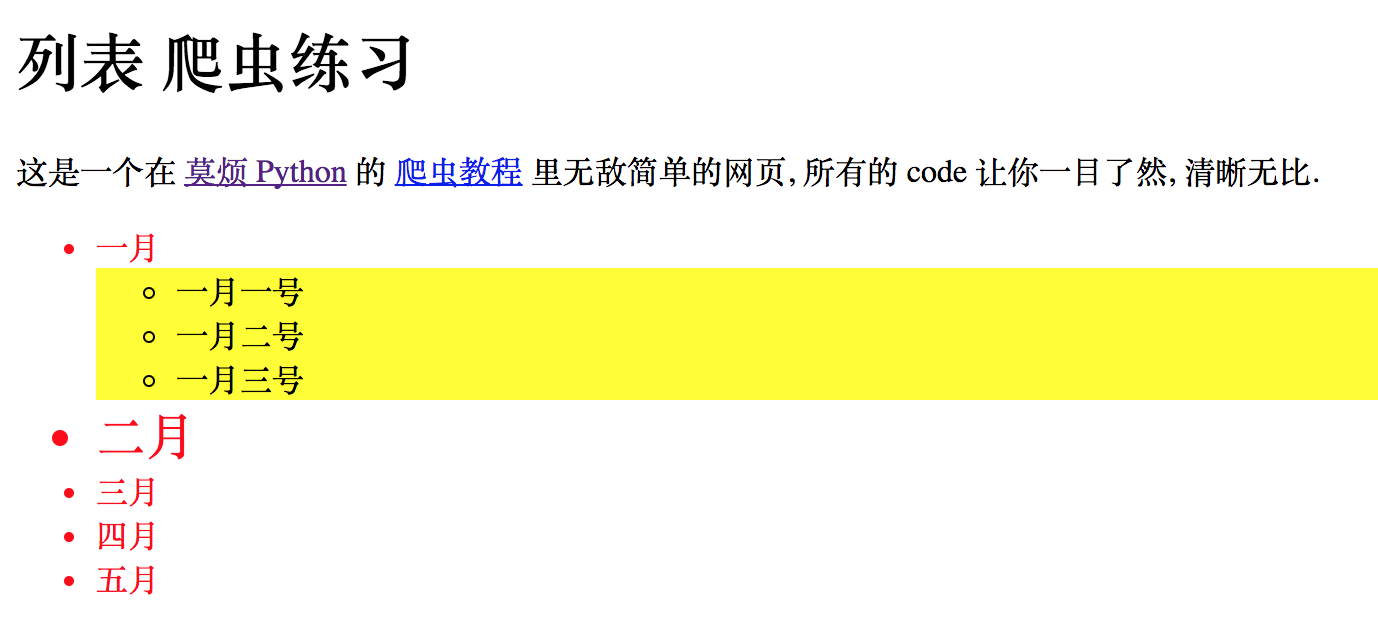
里面的字体/背景颜色, 字体大小, 都是由 CSS 来掌控的, CSS 的代码, 可能就会放在这个网页的 < head> 中
```python
from bs4 import BeautifulSoup
from urllib.request import urlopen
# if has Chinese, apply decode()
html = urlopen("https://morvanzhou.github.io/static/scraping/list.html").read().decode('utf-8')
print(html)
```
```markup
...
...
```
在 < head> 中,被放在 < style> 里面的都是某些 class 的 CSS 代码.,比如 jan 就是一个 class,jan 这个类掌控了这个类型的背景颜色,所以在 < ul class="jan"> 这里, 这个 ul 的背景颜色就是黄色的,而如果是 month 这个类, 它们的字体颜色就是红色
## 按 Class 匹配
找所有 class=month 的信息. 并打印出它们的 tag 内文字.
```python
soup = BeautifulSoup(html, features='lxml')
# use class to narrow search
month = soup.find_all('li', {"class": "month"})
for m in month:
print(m.get_text())
"""
一月
二月
三月
四月
五月
"""
```
找到 class=jan 的信息. 然后在 < ul> 下面继续找 < ul> 内部的< li> 信息
```python
jan = soup.find('ul', {"class": 'jan'})
d_jan = jan.find_all('li') # use jan as a parent
for d in d_jan:
print(d.get_text())
"""
一月一号
一月二号
一月三号
"""
```